Embedded Sound Recognition SDK: Nine Models, One Path from Algorithm to Mass ProductionNEW
One Delivery Path for Device-Side Sound Recognition
Smart cameras, baby monitors, sleep devices, pet products and public-safety systems all share the same foundation: sound understanding that runs on the device itself. Instead of stitching together multiple vendors and frameworks, soundSDK delivers nine production-ready sound recognition models through one unified C SDK.
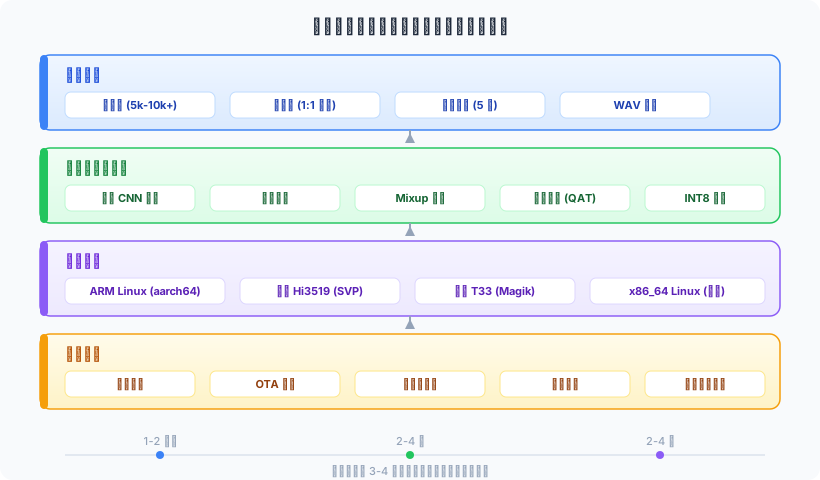
The Nine Models at a Glance
All nine engines share the same detection paradigm — event-based recognition: locate the acoustic event first, verify it with time-frequency evidence, and output onset/offset with a confidence score.
Why On-Device, Not Cloud
How Sound Recognition Works
Every engine follows the same three-stage pipeline, optimized per sound type.
Stage 1: Signal Preprocessing
Adaptive noise suppression — — in typical home noise, SNR improves by roughly 5–10 dB
Framing — — 25 ms frames with 10 ms hop, Hamming window to reduce spectral leakage
Data augmentation (in training) — — speed perturbation, noise mixing and RIR convolution for real-world generalization
Stage 2: Feature Extraction
Time domain — — short-time energy, zero-crossing rate, autocorrelation
Frequency domain — — spectrogram → Mel filterbank → MFCC / FBank, plus spectral centroid and band energy ratios
Deep models learn directly from Mel-spectrogram features; classical models use MFCC coefficients. Delta and delta-delta features extend both.
Stage 3: Recognition Algorithms
Classical — SVM and Random Forest — strong on small datasets with clear features
Deep learning — lightweight CNN for local spectral patterns; CNN+LSTM hybrids to capture temporal structure
Practical choice — a lightweight CNN with event-based post-processing hits the accuracy/latency balance required by embedded products; transfer learning and ensemble techniques further close the gap
Platform Adaptation: HiSilicon SVP and Ingenic Magik
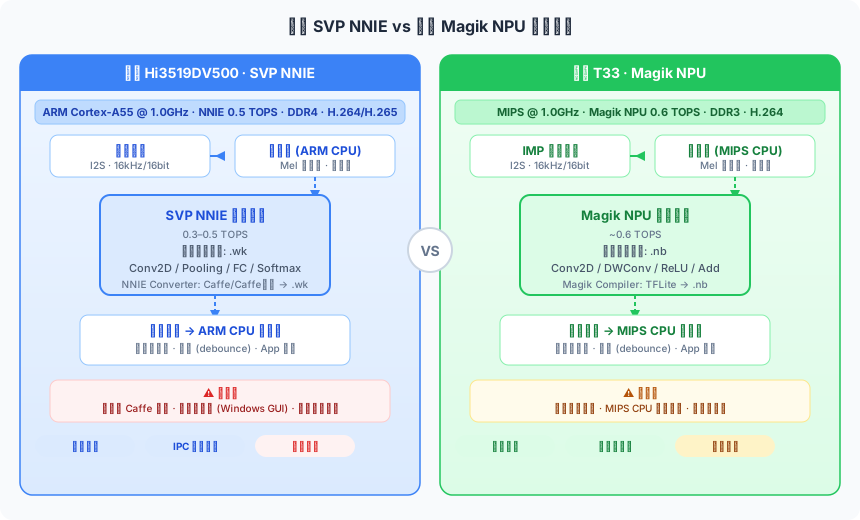
The SDK abstracts both backends behind one API — develop on a generic ARM board, deploy to either NPU without changing application code. Pure-CPU deployment remains available on ARM/MIPS/x86 when no NPU is present.
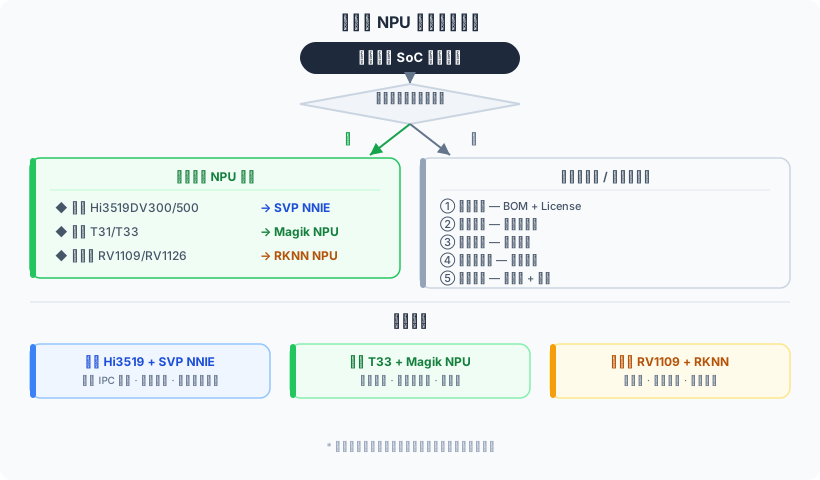
Integration Path: From Evaluation to Volume Production
1. Try online — upload your own audio and check detection quality
2. Get the trial SDK — full-feature trial license with pre-compiled libraries
3. Integrate — one C API; typical integration is measured in days
4. Validate — run field trials on real hardware and microphones
5. License — per-device licensing with OTA model upgrades
Production Practices That Keep Products Healthy
License binding — — bind to device unique ID with offline verification
OTA model updates — — update models without flashing firmware; keep a fallback
Watchdog resilience — — auto-restart detection without affecting the main application
Continuous improvement — — field samples reported by integrators feed directly back into development; models and thresholds keep improving via OTA
Performance monitoring — — log inference latency and CPU usage; alert on drift
Conclusion
Nine sounds, one SDK: this is what "sound intelligence as a component" looks like. Whether you are adding a single capability to a doorbell or building a multi-sound sensing platform, start with the live demo — our engineers will help you from evaluation to mass production.
Want to try the detection yourself?
Continue Reading
- Embedded Baby Cry Detection: Offline Cry Recognition SDK for Edge Devices
- Embedded Glass Break Detection: Offline Break Recognition SDK and Deployment
- Embedded Gunshot Detection: Offline Gunshot Recognition SDK for Public Safety
- Embedded Cat Sound Detection: Offline Meow Recognition SDK with Cry Discrimination